Gwyneth Paltrow: A Style Icon's Journey Through the Nineties
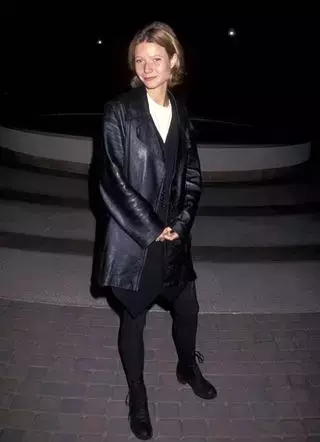
This report delves into the remarkable fashion journey of Gwyneth Paltrow during the 1990s, a period that cemented her status as a global style icon. Her sartorial choices, ranging from minimalist ensembles to high-fashion designer creations, intricately mirrored the decade's evolving trends. Paltrow's innate elegance and discerning eye for design allowed her to navigate the fashion landscape with remarkable grace, leaving an indelible mark on contemporary style. Her influence extended beyond mere trends, showcasing a profound understanding of cut and form that transcended the fleeting nature of fashion. This exploration highlights how her personal style, often characterized by its effortless sophistication, became a significant part of the cultural narrative of the 1990s.
Gwyneth Paltrow's Defining Nineties Fashion Moments
In February 1998, a pivotal moment in Gwyneth Paltrow's fashion narrative unfolded as she graced the cover of British Vogue, coinciding with the promotion of Alfonso Cuarón's cinematic adaptation of Great Expectations. The film's costume design, masterfully executed by Donna Karan, predominantly featured verdant hues, adhering to Cuarón's specific vision. Paltrow, with her characteristic wit, humorously noted Cuarón's "green problem," yet her portrayal in these outfits captivated fashion enthusiasts.
Long before this, Paltrow had already emerged as a leading figure of 1990s minimalism, her influence often paralleled with that of Carolyn Bessette-Kennedy. As early as 1996, the New York Times, reporting from Milan Fashion Week, declared her the actress every designer aspired to dress. A retrospective glance at her wardrobe from this era reveals a fascinating chronicle of the decade's stylistic shifts: from the sleek Calvin Klein slips of 1995 to the bold designs of Tom Ford's Gucci in 1996, and the sophisticated tailoring of Stella McCartney's Chloé in 1997.
Renowned designers and fashion luminaries frequently lauded Paltrow's distinctive appeal. Tom Ford, in the early 2000s, spoke of her "Grace Kelly-Audrey Hepburn quality," emphasizing her unique, understated elegance. Karl Lagerfeld succinctly described her as "the modern woman." However, it was Plum Sykes, in a March 2002 American Vogue profile, who perhaps best encapsulated the essence of Paltrow's 1990s style. Sykes recounted an intimate glimpse into Paltrow's Manhattan wardrobe, describing it as a compact space with soft vanilla carpeting and cream-painted cupboards, embodying a deceptive simplicity that, like Paltrow herself, concealed profound depth, revealing a treasure trove of Gucci, Prada, and Yves Saint Laurent upon closer inspection.
Sykes characterized Paltrow as a "quintessential fashion child of the '80s," observing her ability to distill the extreme sophistication and conservative chic of that era while deftly avoiding its overt flashiness. Paltrow, according to Sykes, prioritized precise cuts over fleeting trends, impeccable finish over raw sex appeal, and consistently maintained the importance of a clean, defined line. Yet, Paltrow herself maintained that her fashion choices were driven by instinct rather than calculation. "I just love clothes," she confessed to Vogue, asserting that her style was simply an authentic extension of herself, free from any premeditation.
Paltrow's journey through the 1990s serves as a compelling reminder that true style is often an intrinsic quality, a blend of personal taste, confidence, and an intuitive understanding of clothing. Her ability to embody diverse fashion aesthetics while retaining an unmistakable personal signature inspires us to embrace authenticity in our own choices. Her legacy demonstrates that fashion is not merely about following trends but about cultivating a distinctive identity that resonates with timeless elegance.